

Is There A Youtube Video Of Valmatic Ball Valve Repair

Differences in control valve designs and how spending a fleck more can save a lot more than than toll direct related to the valve.
The typical control valve is a world valve with a screwed/welded in the seat, the plug guided on 1 place in the body or has an boosted guide below the plug or in a cage and is operated with a single-acting diaphragm actuator that operates with air pressure on 1 side and springs on the other side.
For many applications this might do merely fine, for applications where the bar is set up higher because of the application or required availability there is another solution from Mascot: heavy-duty 1 piece plug & stem with double bonnet guiding with a double-acting piston actuator.
If you await at the pictures you already see some of the difference but permit me explain in more detail.
A traditional control valve with a diaphragm actuator can have a screwed-in seat. These should be replaceable only in many cases, this volition accept some or a lot of effort. The threaded connection can be the beginning of a potential leak path. When the seat is welded in or seal welded later information technology is screwed in information technology's more than of what is already mentioned applies to replace it. The plug and seat need to be perfectly aligned otherwise in that location volition exist a bending force on the stem.
A clamped in seat has a seal betwixt de seat and the trunk that is compressed until there is metal to metal contact between seat and body. This way there is no potential start of a leak path. The seat is held down by a muzzle that is held in place by the bonnet flange. Before the bonnet bolts are tightened the plug has centered the seat. This way there are no angle forces on the stalk.
Heavy duty stem typically double the diameter of standard stem resulting in a bigger guiding surface. The bigger the surface the smaller the force on the guide which results in less habiliment. This will speak for itself, more than area with the same force is a lower pressure resulting is less vesture.
Heavy-duty stems don't interruption. Vibrations tin can occur in a control valve, a stem with a smaller bore will break quicker than a larger diameter. Again 1 that is quite obvious, more material to resist the forces is less gamble of damage.
The plug and stem are 1 slice. Plugs that have come loose from the stem with a traditional control valve are non uncommon. When the disc is connected to the stem with tolerance to recoup for plug/seat misalignment this can exist the start of a problem equally vibrations can have serious harm as result.
Like shooting fish in a barrel maintenance, loosen the bonnet and the seat ring can exist replaced without whatsoever further tools as it is but clamped in. Does the process change and the Cv value needs to be changed, easily supplant the plug & seat. This is not as easy when the seat is screwed in or seal welded.
A Piston actuator merely has one/3 of parts compared to a diaphragm actuator. Easier maintenance, less inventory. i.000.000 cycles is quite normal for a piston actuator
A piston actuator has 1/ten of the operational cost compared to diaphragm actuator. Merely a few O-rings are the normal replacement parts.
Easily reversable, detach the actuator and identify the leap at the other side of the actuator. It'due south just 1 jump.
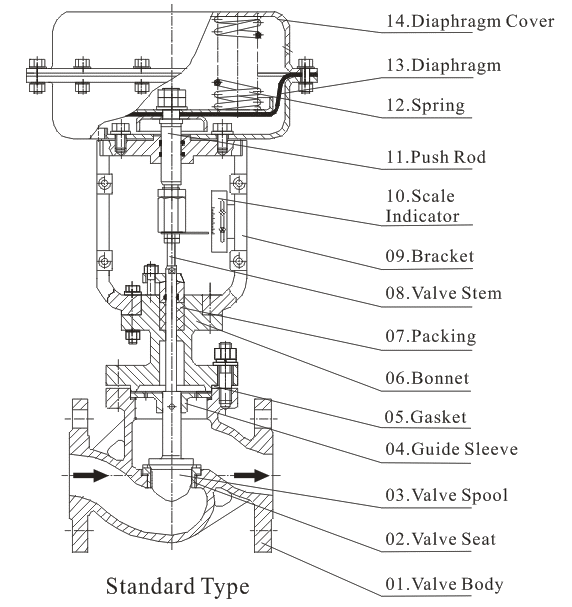
High stiffness, good repeatability depression hysteresis. A diaphragm actuator has a relatively large volume compared to a piston actuator. Air is compressible, more air result in bigger differences. Air can permeate through the diaphragm, 3 % on average, typically with older ones only it means the position is not maintained without calculation air. The diaphragm is susceptible to aging which will make it less flexible and information technology will reply less linear, this will be seen in accurateness.
A piston actuator is compact (infinite saving) and light weight, typically diaphragm actuators are bigger and heavier. Peculiarly with bigger valves this is significant.
The spring in a piston actuator is just for fail prophylactic as for normal operation air is used on both sides, a diaphragm actuator is dependent on spring to close or open the valve based on the neglect action.
Higher speeds / faster stroking is possible with piston actuators than diaphragm actuators. The ist reason is the lower book in the piston actuator. The 2nd is that a piston actuator is operated on both sides of the piston with compressed air where i side is supported by the jump. A diaphragm actuator only has air on 1 side.
Piston actuators can handle up to 10 bar supply air possible, so smaller actuator possible if constantly available..
So a technically strong blueprint that price less to maintain, requires less maintenance, provides better control then a better product from the process and has a higher availability and shorter downtime. This results in a cheaper valve if you consider cost of ownership of the valve and better operational results.
This article is published by
Founded in 1797 and providing customers with valve & actuator solutions from our representations Cameron (Orbit, General Valve, WKM, Grove, Ledeen. Entech, Douglas Chero, Demco, , Newco, Maxtorque, Dynatorque (Tom) Wheatley), Xanik, ISV, QTRCO & UNP Polyvalves. Many products can be supplied with curt delivery fourth dimension, besides the brands nosotros represent ...


Is There A Youtube Video Of Valmatic Ball Valve Repair,
Source: https://fluidhandlingpro.com/mascot-control-valves/
Posted by: kelleymustgais69.blogspot.com
0 Response to "Is There A Youtube Video Of Valmatic Ball Valve Repair"
Post a Comment